What kind of conversation is this?
Have you ever noticed that at the beginning of a project or working relationship, conversations are friendly and easy, but as the collaboration progresses, things can start to become more... complicated?
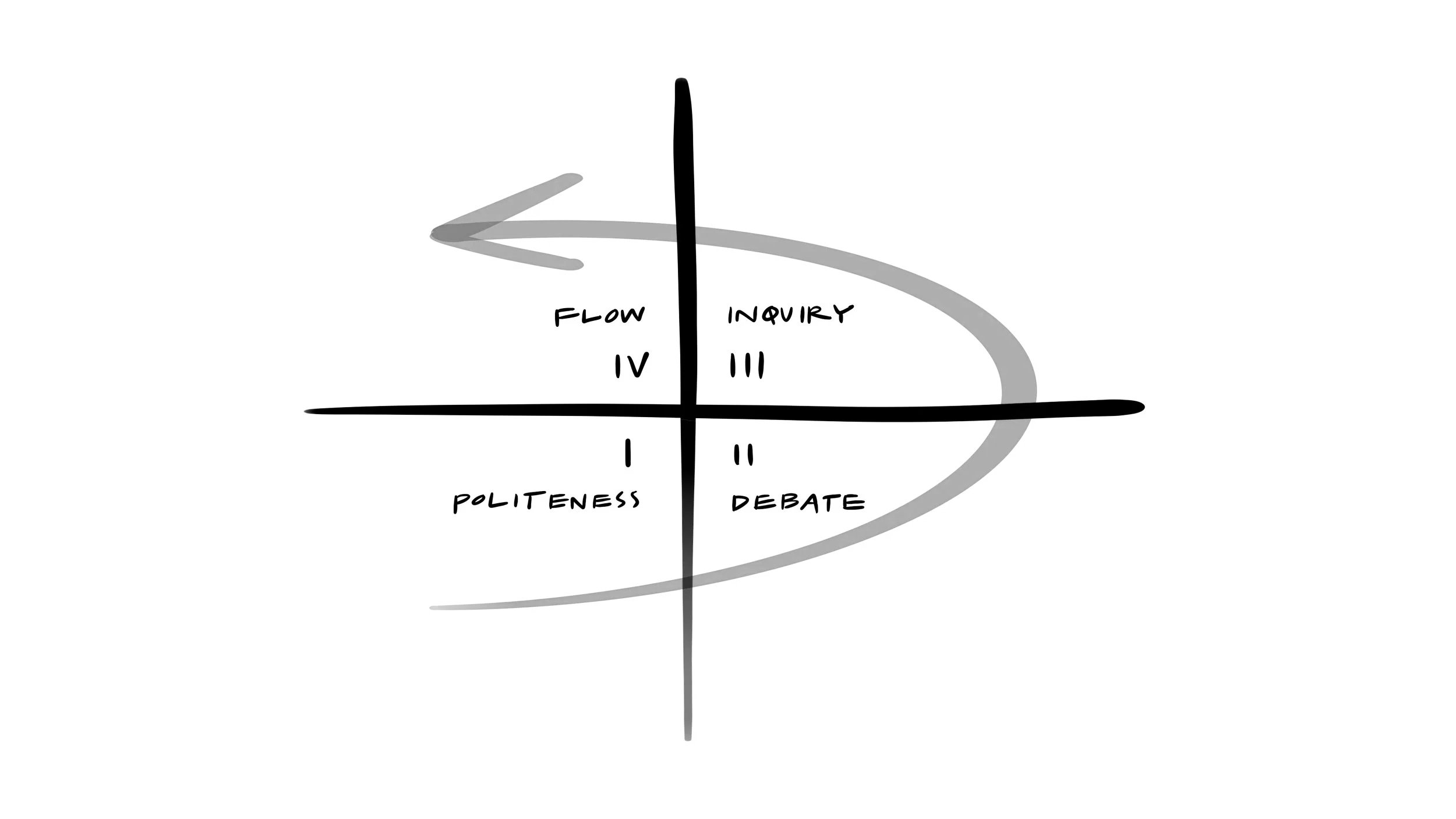
This model by Bill Isaacs and Otto Scharmer can help us better understand why this happens and what it means. They describe four different levels or fields of conversation, patterns we see in teams when they collaborate:
1 - Talking nice (politeness): We aim to be kind and polite, to please others, fit in, and avoid conflict. We don't share what we really think, and we adapt to the needs of the group or person in a position of power. The problem with this type of conversation is that there is no room for honest feedback and exchange of ideas.
2 - Talking tough (debate): We begin to share what we really think, without worrying so much about the opinions of others, and as a result, conflicts or tensions tend to arise. The conversation is enriched with different points of view, but it can become a series of monologues, as each person is attached to their own point of view.
3 - Reflective dialogue (inquiry): It may be that, due to discomfort or a desire to avoid conflict, we return to level 1 — the comfort zone where everyone is nice and polite. Or, in some cases, we manage to build trust and move from debate to dialogue. Here, we can speak from our own perspective while exploring new ideas. We open up to fresh perspectives, and speak toward a kind of center or common ground, instead of debating with one another. We recognize that we are part of something larger, and inquire from a place of genuine curiosity instead of simply defending our own point of view.
4 - Generative dialogue (flow): At this level, we enter a co-creative space, speaking and thinking together from our collective potential. What is possible? We refer to this type of conversation as generative because new ideas and possibilities are born.
In this video, Otto Scharmer explains the model in greater detail.
Using graphic facilitation, we can help you to create the conditions for deeper conversations and activate collective intelligence. Get in touch today to find out how.